share
For supply chain leaders across planning, logistics, and operations — this is what the next operating model looks like.
A Day in the Life of a Supply Chain Executive
It’s 8:30 AM.
Overnight, demand shifted in one region. An inbound shipment missed a milestone.
Before the first meeting, the supply chain executive has already logged into multiple systems—checking orders, inventory, ETAs, and overnight escalations.
(And yes—this all happens before the first coffee.)
None of this work is intellectually hard—but it is relentless.
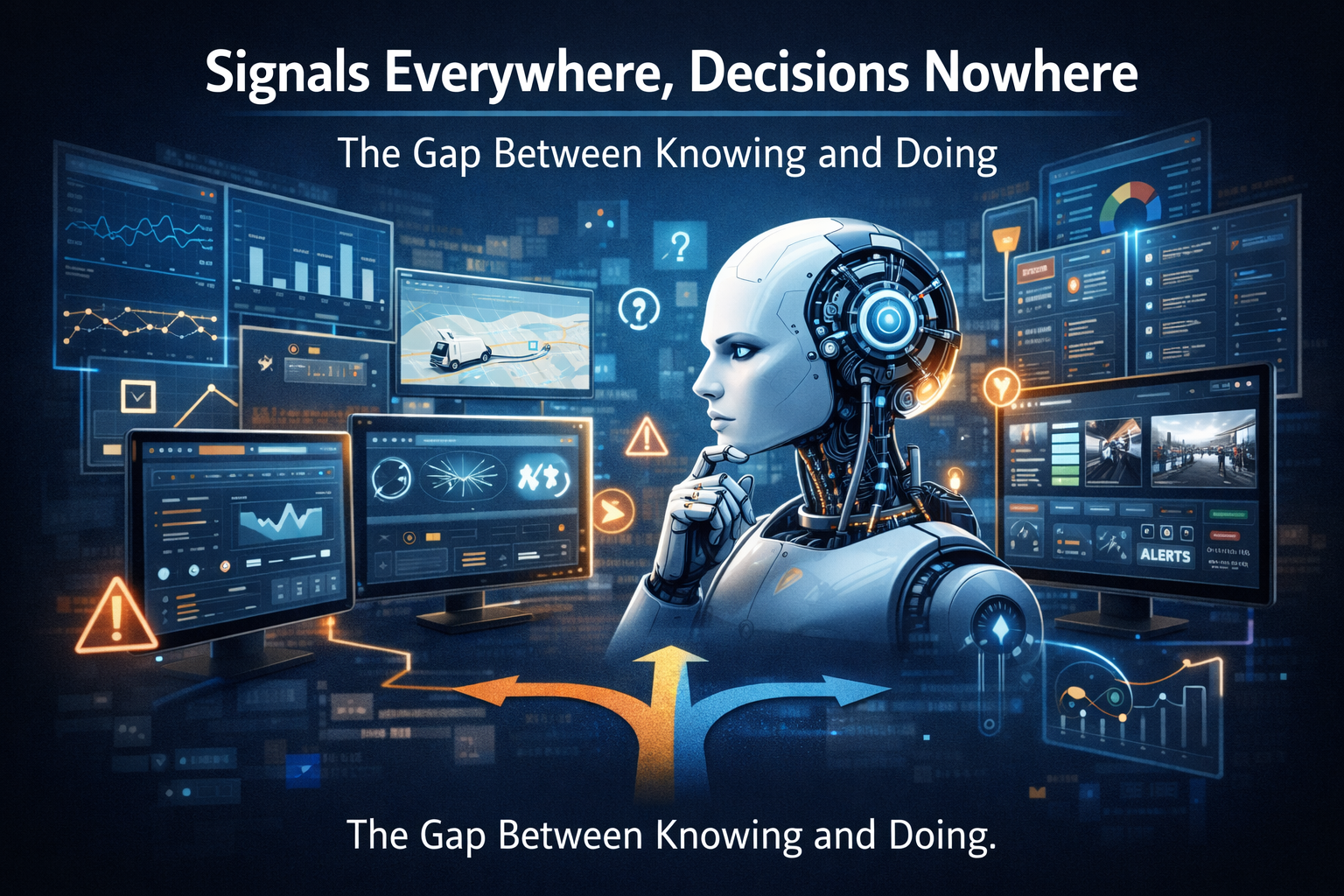
Why Visibility Alone Is No Longer Enough
Most supply chains already have visibility. They can see where shipments are, how much inventory is available, and which orders are at risk.
For example, a late inbound shipment may be visible in the system—but unless someone connects it to affected customer orders, reprioritizes inventory, or triggers alternate sourcing, the insight arrives too late to matter.
Modern supply chains need more than awareness. They need continuous interpretation, decision-making, and action—what many now call closed-loop execution.
Visibility shows what happened. Digital teams decide what happens next.
Introducing the Digital Supply Chain Team
Now imagine a digital team that works alongside your human teams.
This team continuously observes demand, inventory, orders, and execution—acting automatically when outcomes are clear and escalating only when judgment is required. This is not isolated automation.
For instance, when demand spikes unexpectedly in one region, the digital team detects the shift, checks available inventory across nodes, evaluates service risk, and recommends or executes reallocation. This is how execution becomes proactive rather than reactive.
AI Agents: Reasoning Across Planning and Execution
At the core of this digital team are AI Agents.
Unlike traditional automation, AI Agents are goal-driven. They reason toward outcomes rather than follow predefined rules. Their goals include protecting service levels, reducing delays, and maintaining reliable order commitments.
They connect data from different systems, maintain context over time, and understand cause and effect. This allows them to move beyond monitoring. They support decision intelligence—identifying what matters, what’s at risk, and what should happen next.
They don’t just detect issues; they interpret impact and recommend action.

Computer Use Agents: Turning Decisions into Action
Decision-making alone doesn’t change outcomes unless it is executed.
This is where Computer Use Agents (CUAs) come in.
CUAs operate at the interface level, interacting with enterprise systems the same way humans do—logging in, navigating screens, entering data, and triggering workflows. Instead of relying on brittle integrations or rigid APIs, they work directly through user interfaces.
This makes them especially powerful in environments where modern and legacy systems coexist. If a human can perform a task on a screen, a CUA can do it too—securely, consistently, and at scale.
Traditional automation depends on fixed integrations. CUAs rely on natural language and visual understanding instead. This dramatically reduces complexity and cost.
This shift is already underway. Platforms such as OpenAI and Microsoft Copilot Studio are enabling agents that can reason and act across enterprise workflows, while operators like Maersk and DHL are beginning to deploy agentic systems across supply chain operations.
How Computer Use Agents Actually Work
What makes CUAs different from traditional automation is adaptability.
They adapt to changing screens and workflows, operate securely through managed credentials, and enforce rules that ensure compliant execution. When workflows evolve, they interpret what they see rather than follow a fixed script.
This allows organizations to automate execution without rewriting systems or waiting for perfect integrations. CUAs simply work with what already exists.
In other words, the system adapts—people don’t have to.
From Logistics Planning to Real-Time Execution—and Beyond
In logistics, the impact is immediate.
AI Agents continuously monitor transport plans in real-time. Predictive models identify ETA risks early. CUAs then validate status across systems, trigger proactive follow-ups with carriers, update shipment or order status, and escalate only when necessary.
But this approach doesn’t stop at logistics.
When a shipment delay threatens inbound inventory, the same digital team evaluates downstream impact. Inventory risk is flagged, order promises are revalidated, and fulfillment priorities can be adjusted automatically. Planning and execution stay connected—not through meetings or emails, but through real-time coordination across systems.
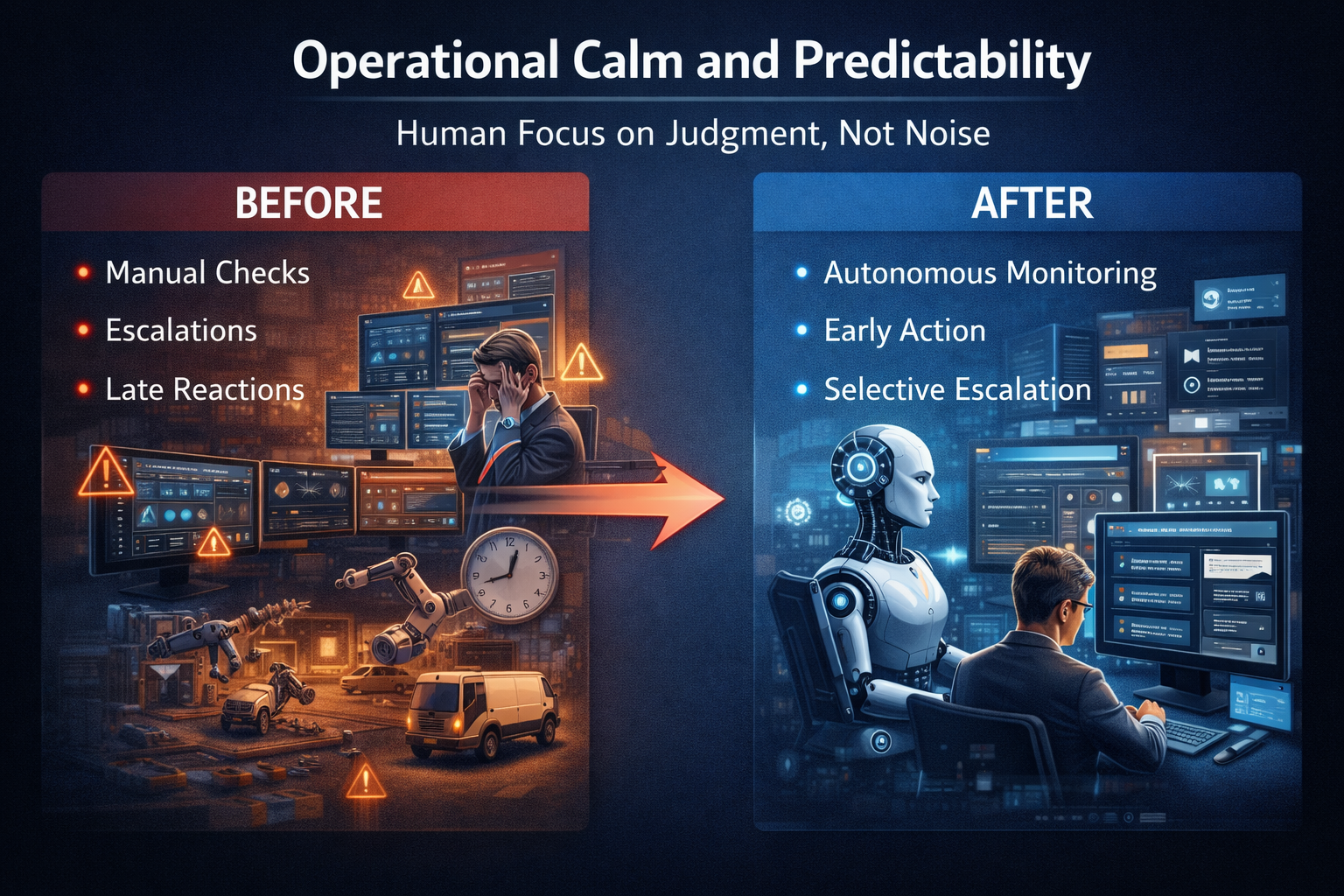
The difference is clear:
Before:
- Teams keep checking multiple systems throughout the day.
- Issues are discovered late, often after service is already at risk.
- People react to surprises and spend time firefighting.
After:
- A digital team monitors everything continuously.
- Routine issues are resolved automatically.
- People are alerted only when a real judgment call is needed.
What Humans Do in a Digitally Operated Supply Chain
As digital teams take over continuous monitoring and routine execution, human roles don’t disappear—they evolve.
Humans focus on judgment—balancing cost and service, managing relationships, and refining operating policies
Digital teams handle the scale.
Humans handle the nuance.
From Firefighting to Orchestrated Operations
Today, many supply chains succeed because teams react quickly under pressure.
Tomorrow, success will come from anticipation. Issues will be detected earlier, actions will be coordinated automatically, and escalations will be intentional rather than frantic.
Operations become calmer, more predictable, and more resilient.
The Future: Human and Digital Teams Working Together
The future of supply chains isn’t about working harder or reacting faster.
It’s about designing systems that think, act, and adapt - so people can lead with clarity, not urgency.
