share
OVER 500+ FUEL SURCHARGE CONFIGURATIONS HAD TO BE CREATED MANUALLY IN ONE OF OUR TMS IMPLEMENTATIONS. ONE. AT. A. TIME.
When automated, the entire process was completed in just two hours, saving several days of effort. That experience didn’t just save time on one project. It fundamentally changed how I think about TMS implementation — and it should change how our entire industry thinks about execution.
THE HIDDEN BOTTLENECK NOBODY TALKS ABOUT
The supply chain industry invests billions in Transportation Management Systems promising scale, speed, and intelligence.
A typical enterprise TMS rollout requires creating hundreds — sometimes thousands — of:
- Freight bill versions and voucher configurations
- Plan IDs and logistics group assignments
- Fuel surcharge structures and rate tables
- Carrier onboarding and lane definitions
Each entry must be configured precisely. Each configuration must align with complex business rules. And in most implementations today, each one is still created manually.
At small volumes, this is annoying. At enterprise scale, it becomes the project’s single biggest constraint — not the platform’s capabilities, not the algorithm’s sophistication, but the sheer manual labour of standing it up.
WHY THIS HITS YOUR BUSINESS HARDER THAN YOU THINK
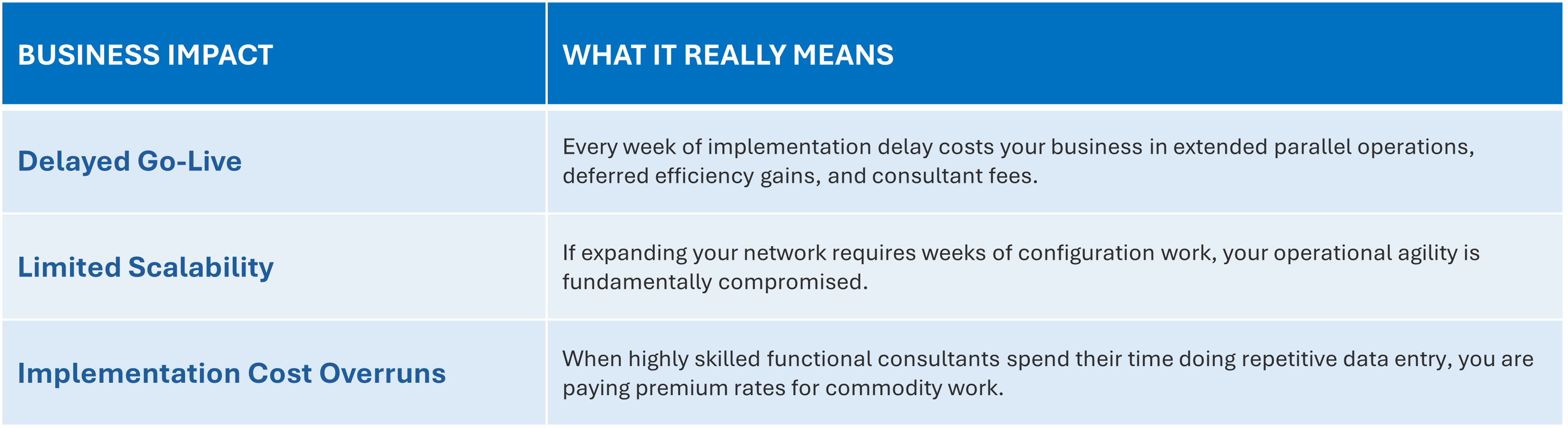
This isn’t just an execution inconvenience. Manual configuration at scale directly shapes your business outcomes:
WHAT THE AUTOMATION-FIRST MINDSET ACTUALLY LOOKS LIKE
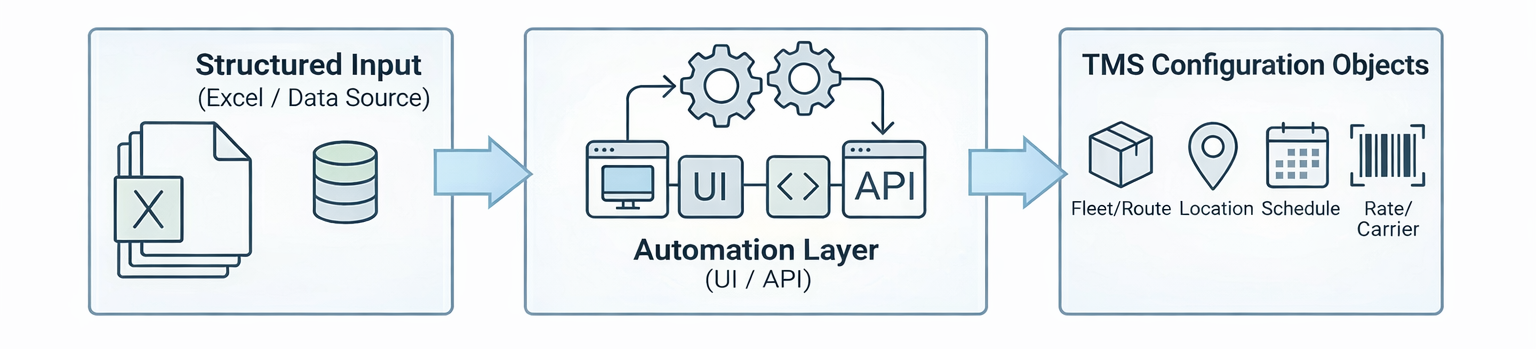
The shift isn’t about replacing your TMS platform’s native capabilities. Most enterprise platforms already offer APIs and configuration loaders — and those should always be the first option. The automation-first mindset addresses the gaps: the UI-only workflows, the high-volume repetitive tasks, the configuration patterns that your platform’s tooling wasn’t designed to bulk-automate.
In practice, this means treating execution design as a first-class deliverable. Before a single configuration entry is created, we ask: Can this be structured? Can it be automated? Can it be reused?
The execution pattern that emerges:
- Identify: Map all high-volume, repetitive configuration objects before the project begins.
- Structure: Standardize inputs into clean data formats (Excel, CSV, or upstream system feeds).
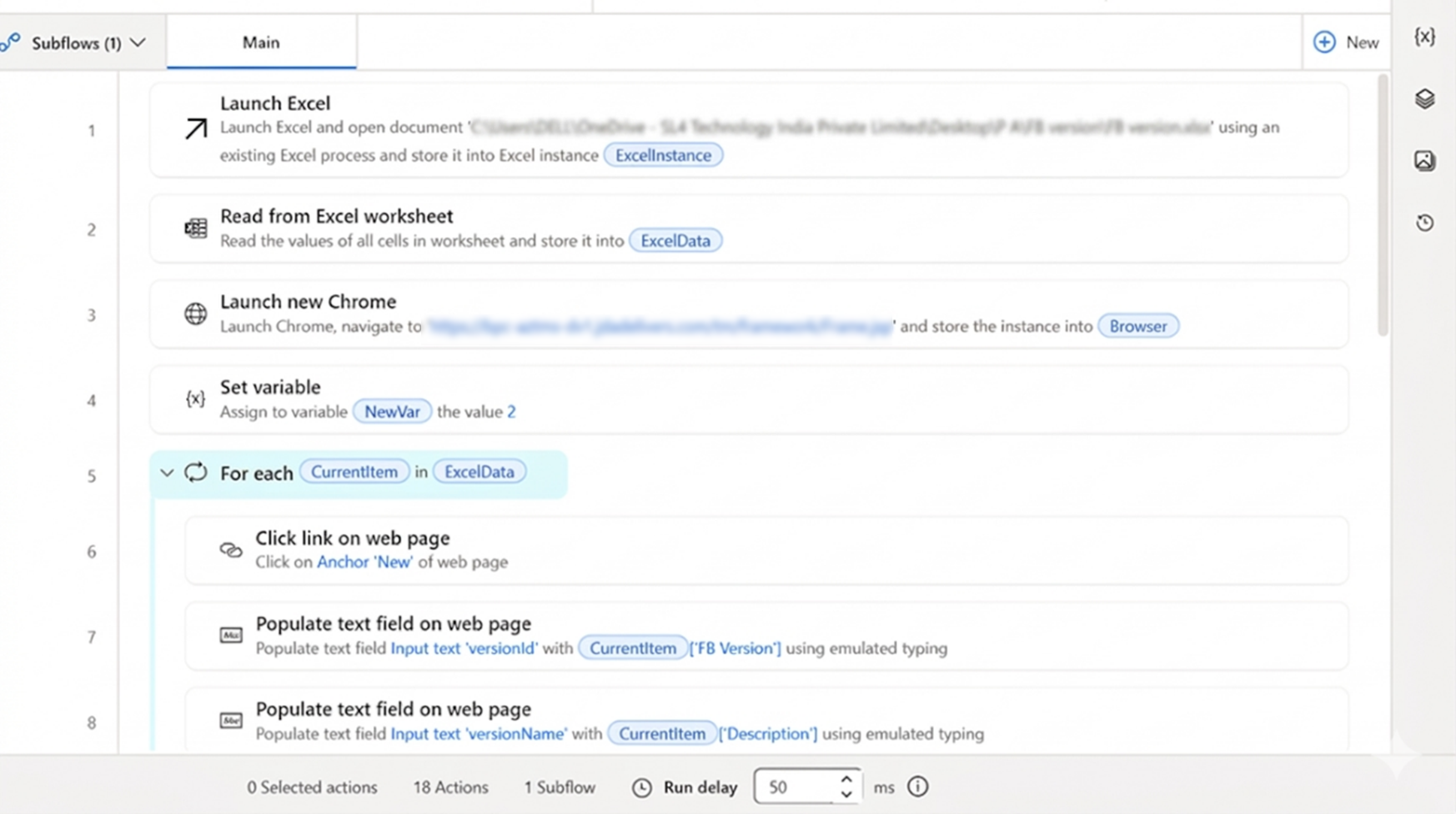
- Automate: Build execution scripts or UI automation flows that process structured inputs at scale.
- Validate: Run controlled submissions with checkpoints, not batch dumps.
- Reuse: Deploy the same automation across DEV, QA, and PROD environments.
NUMBERS THAT CHANGED THE PERSPECTIVE
On a recent enterprise TMS rollout, we applied this approach to a large carrier network configuration.
The scope included:
- 90+ freight bill versions
- 90+ voucher versions
- 90+ plan IDs
- 90+ logistics groups
- 500+ fuel surcharge configurations

In parallel, as teams were exposed to automation-led execution, it enabled the configuration of more complex functionalities, including:
- Smartbench jobs
- Job definitions and templates
- Entity selection criteria
The outcome was not just acceleration—it was the decoupling of scale from effort
THE BIGGER SHIFT: FROM TASK EXECUTOR TO SYSTEM DESIGNER
The technical outcomes matter. But the more significant transformation is cultural. When teams adopt an automation-first approach, something changes in how they think about their work. Repetitive tasks get questioned rather than accepted. Processes get designed before they get executed. Individuals stop thinking like operators and start thinking like builders.
The role of the TMS practitioner is evolving:
- Old model: Execute predefined configuration steps efficiently.
- New model: Design intelligent execution systems that scale without linear effort.
When this mindset scales across implementation teams, the compounding effect is significant. Configuration knowledge becomes transferable. Execution patterns become reusable across clients and environments. What starts as one consultant’s efficiency hack becomes a shared organisational capability.
WHERE THIS FITS IN THE BROADER SUPPLY CHAIN TRAJECTORY
The supply chain industry is moving rapidly toward AI-assisted planning, autonomous execution layers, and integrated digital ecosystems. That future is real and it’s arriving faster than most organisations are prepared for.
But here’s the thing: that future isn’t built solely through advanced algorithms. It’s built through the practical, unglamorous redesign of everyday execution. Automating repetitive configuration is one such foundational step.
The organisations that will lead the next decade of supply chain performance aren’t just buying better platforms. They’re building smarter implementation capabilities — and those capabilities start with asking better questions about how work gets done.
THE QUESTION THAT CHANGES EVERYTHING
Most implementation teams ask: “How do we complete this task?”
The next generation of supply chain implementers will ask: “How should this task execute itself?”
This isn’t a tool-specific approach. It’s a pattern that can be adopted across any TMS platform, any implementation methodology, and any team size. The technology to do it exists today. The mindset shift is what separates teams that scale from teams that grind.
THE STRATEGIC QUESTION FOR SUPPLY CHAIN LEADERS
This transition is already underway. Supply chains are moving from systems that support decisions to systems that participate in making them.
That raises important strategic questions for leaders:
- Where should automation act independently?
- Where must human judgment remain central?
- How should decision authority be distributed across systems, teams, and agents?
These are not just technology decisions. They are architectural decisions that shape how supply chains operate.
THE NEXT PHASE OF SUPPLY CHAIN SOFTWARE
The last generation of supply chain software focused on visibility. The current generation focuses on intelligence. The next generation will be defined by autonomy within governance. Machines are learning to simulate environments. Robots are learning to operate within them. And supply chain platforms are evolving to orchestrate both.
The organizations that adapt their architecture to this reality will operate faster, respond earlier, and coordinate more effectively than those still structured around human-paced workflows. The real question now is not whether this shift will happen.
The question is:
Which supply chain platforms are architected for a world where agents — not users — are the primary operators?
