share
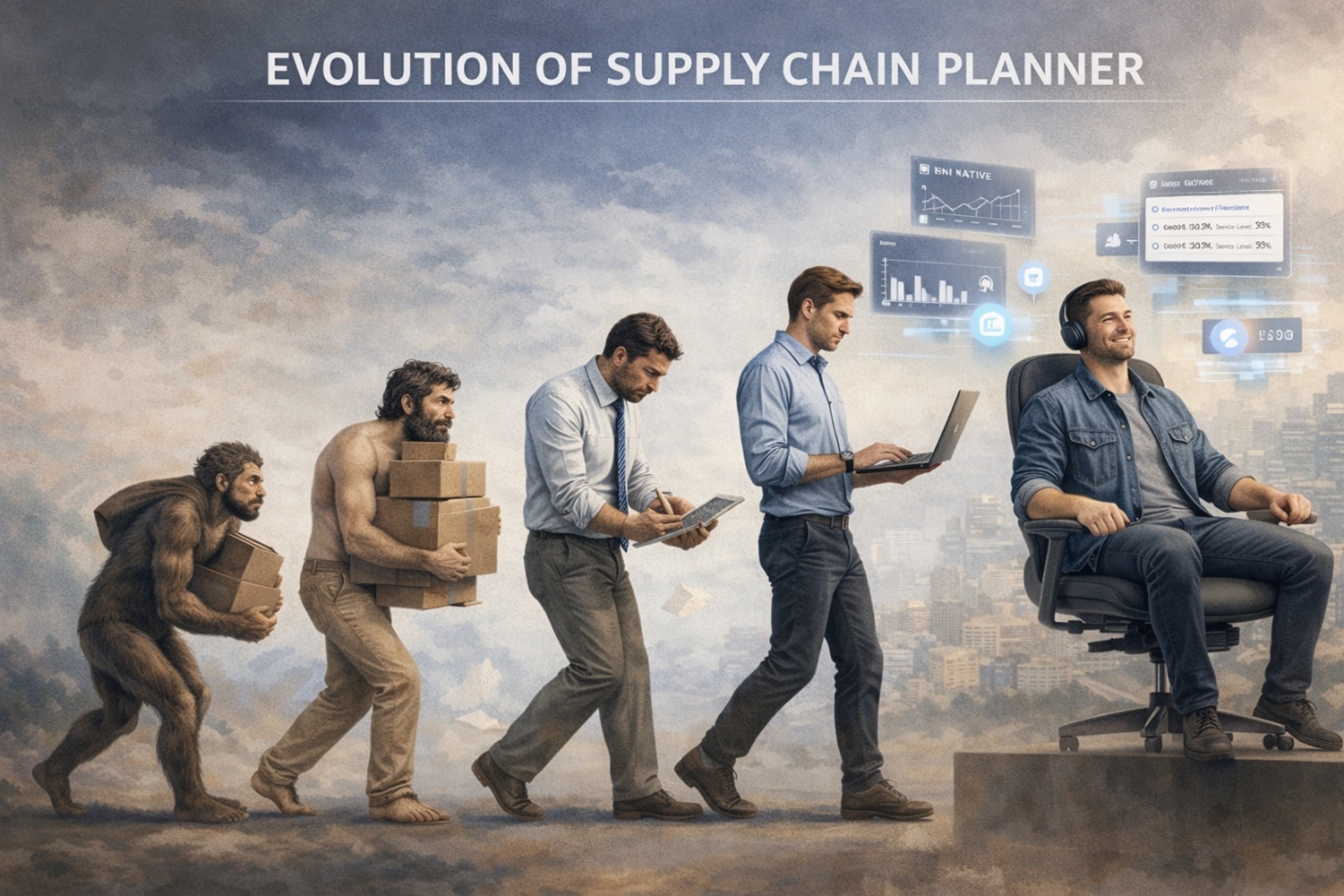
For years, we’ve talked about AI in supply chain as a technology upgrade.
Better forecasts.
Better visibility.
Better automation.
But something much bigger is happening. AI isn’t just improving planning.
It’s redesigning the planner’s job itself. And many organizations haven’t realized it yet.
THE PLANNER ROLE WAS NEVER ONE JOB
Most supply chain planners think they do “planning.” But in reality, their job has always been a bundle of very different activities.
A typical planner spends time on four things:
- Signal ingestion
Reviewing demand signals, shipments, supplier updates, and inventory changes.
- Pattern interpretation
Understanding what the data actually means.
- Scenario construction
Building alternate plans when something changes.
- Stakeholder coordination
Aligning sales, operations, logistics, and suppliers.
Traditional planning systems helped with these tasks. But AI is now starting to own several of them outright. And that’s where the shift begins.
THE THREE PLANNING TASKS AI IS ABSORBING FIRST
Across supply chain organizations, the same pattern is emerging. AI isn’t replacing planners.
It’s replacing parts of the planner’s job. And those parts are surprisingly consistent.
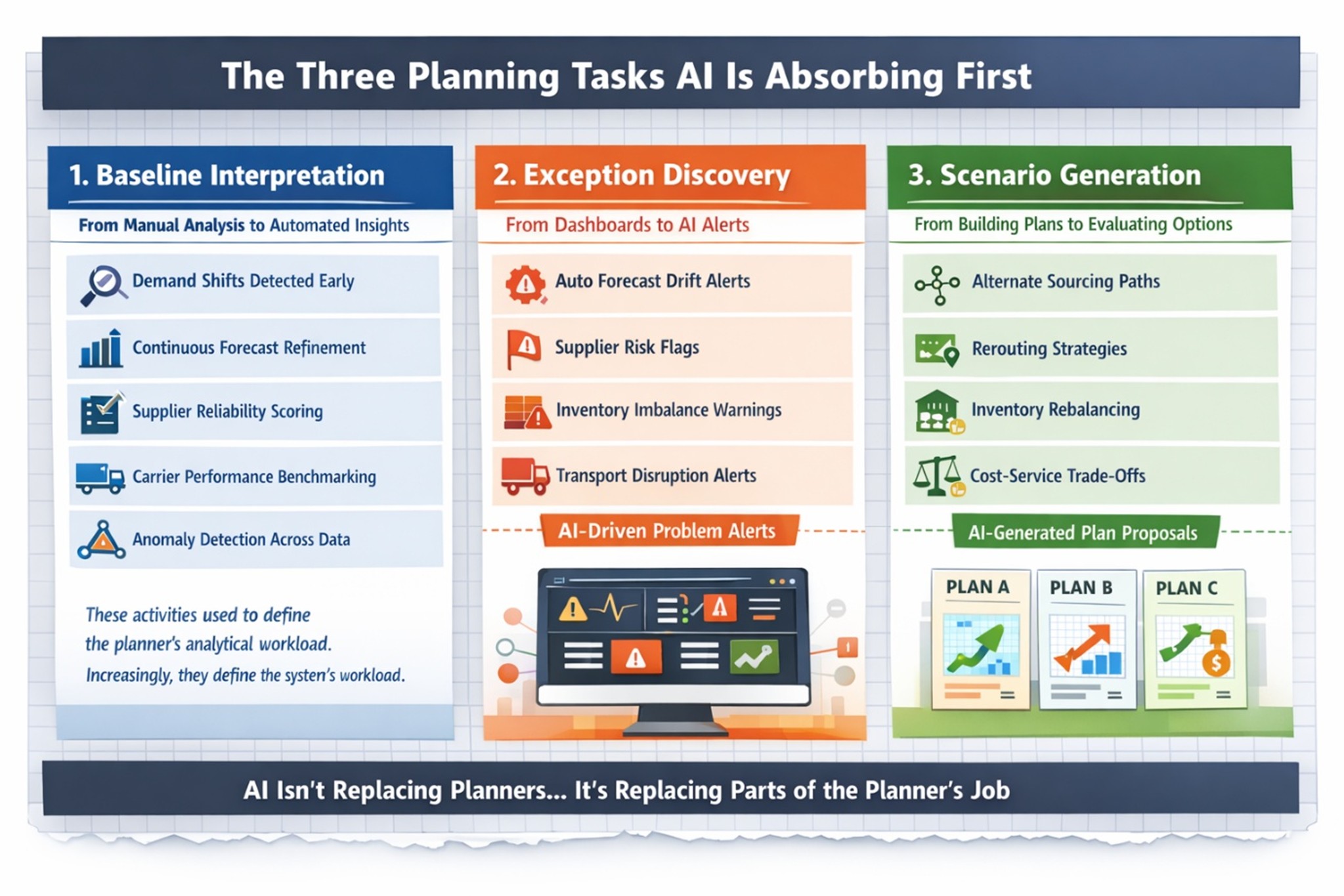
1. Baseline Interpretation
Much of planning work used to involve interpreting patterns in data. Today, AI systems increasingly do that automatically.
They can already:
- detect demand pattern shifts earlier than human planners
- refine statistical forecasts continuously
- score supplier reliability using historical signals
- benchmark carrier performance across thousands of shipments
- identify anomalies across execution data
These activities used to define the planner’s analytical workload. Increasingly, they define the system’s workload.
2. Exception Discovery
Planning used to mean reviewing dashboards looking for problems. AI flips that model entirely.
Instead of planners hunting for issues, systems now:
- detect forecast drift automatically
- flag supplier instability early
- surface inventory imbalances
- identify transportation execution risks
Planning is shifting from review cycles to AI-driven alerts. The planner’s job becomes responding to intelligence, not searching for it.
3. Scenario Generation
This is where the biggest shift is happening. Historically, planners built scenarios manually.
What happens if demand spikes?
What if a supplier misses delivery?
What if inventory moves between warehouses?
Today, modern systems can generate options automatically.
AI can propose:
- alternate sourcing paths
- transportation rerouting strategies
- inventory rebalancing actions
- cost-service trade-off scenarios
Which leads to a profound shift. The planner no longer constructs the plan.
They evaluate competing plans produced by the system. That’s not a productivity improvement. It’s a cognitive role change.
THE RISE OF THE AI-NATIVE PLANNER
As AI absorbs analysis and option creation, the planner’s role moves up the decision chain. The future planner isn’t a data analyst. They’re a decision governor.
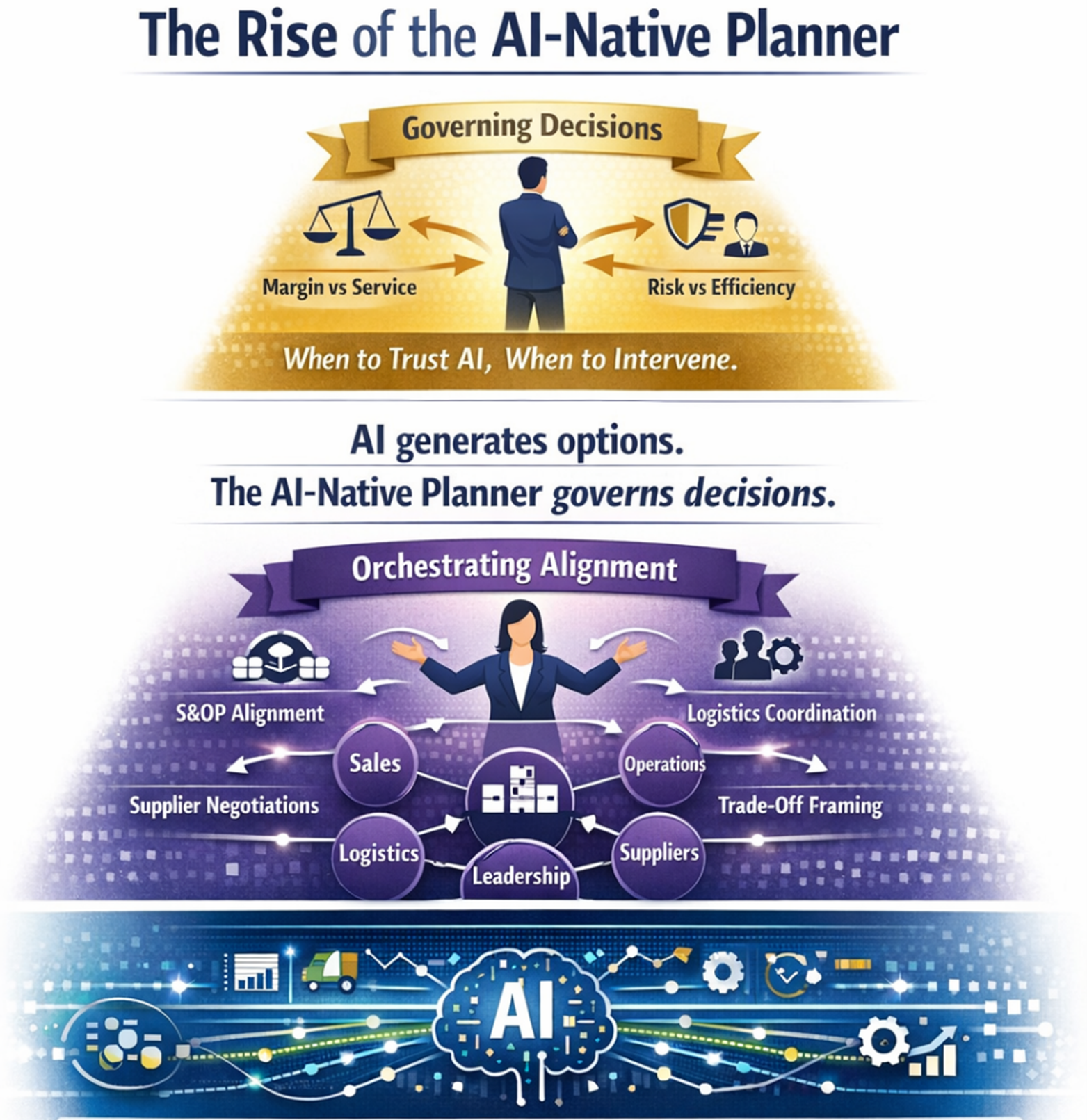
Three capabilities define this new role.
1. Interpreting Ambiguity
AI optimizes based on defined constraints. But supply chains rarely operate under purely mathematical priorities.
Humans remain essential for deciding:
- when margin matters more than service
- when risk outweighs efficiency
- when customer impact overrides optimization
AI can compute trade-offs. But humans still interpret organizational context.
2. Orchestrating Alignment
Even the best scenario fails without stakeholder alignment. This is where human planners become even more important.
AI-native planners spend increasing time:
- aligning sales and operations decisions
- negotiating supplier commitments
- coordinating logistics execution
- framing trade-offs for leadership
The role shifts from analyst to orchestrator.
3. Governing Decision Velocity
AI dramatically accelerates planning cycles. But faster decisions are not always better decisions.
Someone must govern when:
- automation executes immediately
- human intervention is required
- decisions escalate to leadership
In many organizations, planners will become decision velocity governors. Their job is no longer building plans. It’s controlling how fast the organization moves.
THE PERSONAL AI STACK OF THE MODERN PLANNER
Another shift is emerging inside planning roles. Planners are beginning to rely on AI assistants layered on top of enterprise systems. Think of it as a personal AI planning stack.
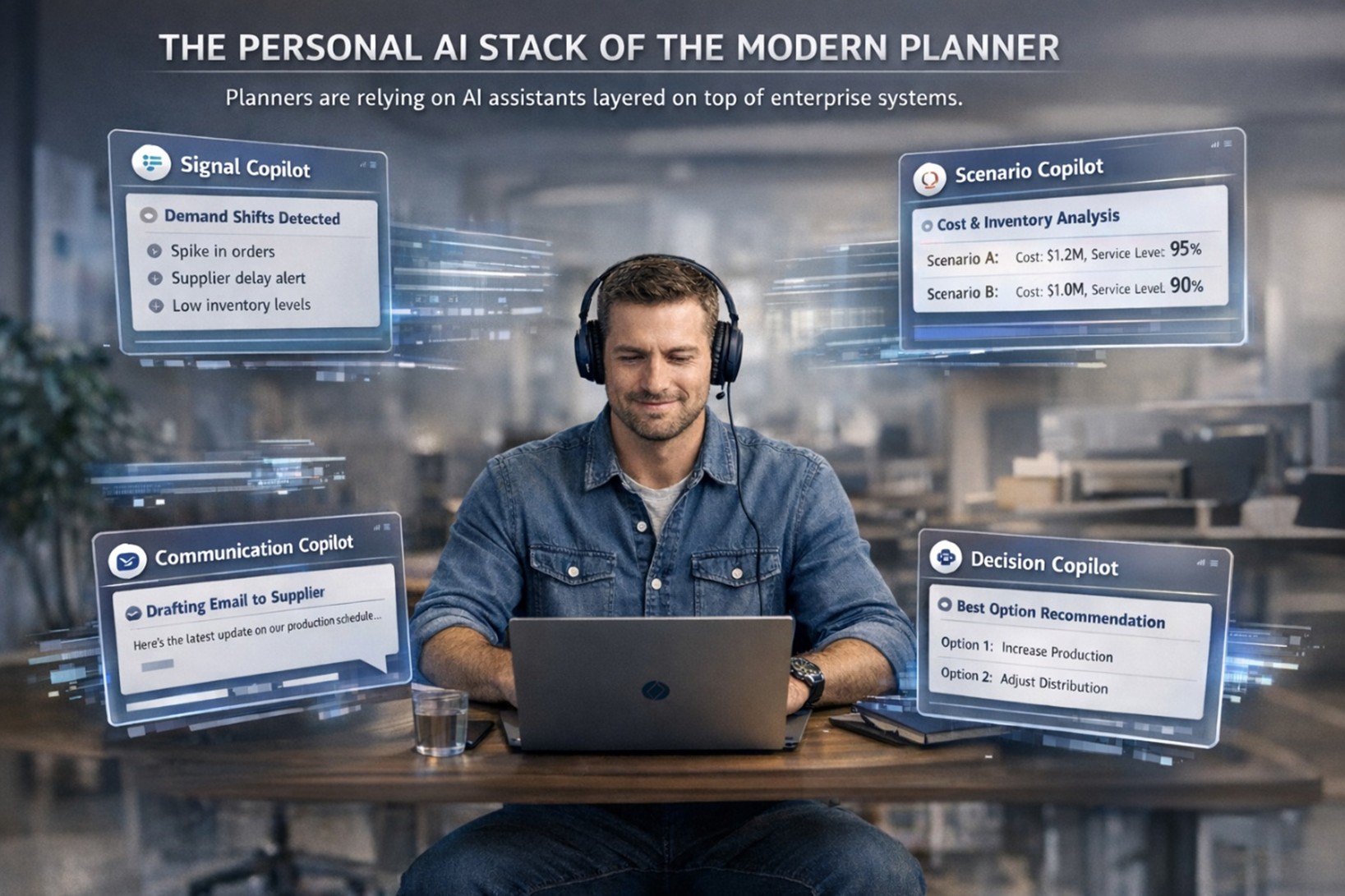
Examples include:
- Signal copilots
Summarizing shifts across demand, supply, and logistics execution.
- Scenario copilots
Quantifying cost, service, and inventory trade-offs instantly.
- Communication copilots
Drafting stakeholder updates or supplier responses.
- Decision copilots
Structuring competing options into defensible recommendations.
The planner’s workspace is no longer a single planning tool. It’s an intelligence environment.
THE REAL ORGANIZATIONAL CHALLENGE
Many companies think becoming “AI-enabled” means buying AI features. But the real challenge is something else entirely. Redesigning planning roles.
That means:
- shifting planners away from manual data work
- reducing time spent constructing scenarios
- measuring decision speed instead of report completeness
- training planners in judgment, not just system navigation
Organizations that succeed won’t just deploy AI. They’ll design roles built for intelligence-driven operations.
THE REAL REDEFINITION OF PLANNING
For decades, planning excellence meant one thing: interpreting data better than competitors.
But in the AI era, data interpretation is becoming automated. The new differentiator becomes something else. How well humans make decisions when intelligence is already available. The planner isn’t disappearing. But the job most planners are doing today absolutely is. And the supply chains that recognize this early will operate faster, align quicker, and adapt far more effectively than those still optimizing yesterday’s roles.