share
MOST SUPPLY CHAIN SOFTWARE TODAY IS BUILT AROUND A SIMPLE ASSUMPTION:
Humans operate the system.
- Planners analyze dashboards.
- Operators follow workflows.
- Managers run periodic planning cycles.
For more than two decades, enterprise platforms were designed to organize information so people could make decisions. But something fundamental is changing. Across both the digital world and the physical world, intelligent systems are beginning to participate directly in decisions — and increasingly execute them. And supply chain software is moving into the center of that shift.
AI IS CHANGING BOTH DIGITAL WORK AND PHYSICAL WORK
Two developments in AI highlight how quickly the paradigm is evolving. On the digital side, new AI systems are being built around world models — environments where machines simulate outcomes, evaluate options, and refine actions before executing them.
Instead of simply analyzing historical data, these systems continuously:
- Observe signals
- Simulate possible outcomes
- Evaluate trade-offs
- Select actions
Decision-making becomes part of the system itself. At the same time, progress in humanoid robotics is pushing similar intelligence into the physical world. Companies like 1X Technologies are building robots designed to operate autonomously in real environments — learning tasks through interaction and executing them with minimal human instruction.
What makes this moment significant is not robotics alone. It is the shared architectural principle emerging across both domains: Machines are moving from assisting humans to operating within environments themselves. And that same shift is beginning to reshape enterprise software.
THE PLATFORM ERA WAS BUILT FOR HUMAN OPERATORS
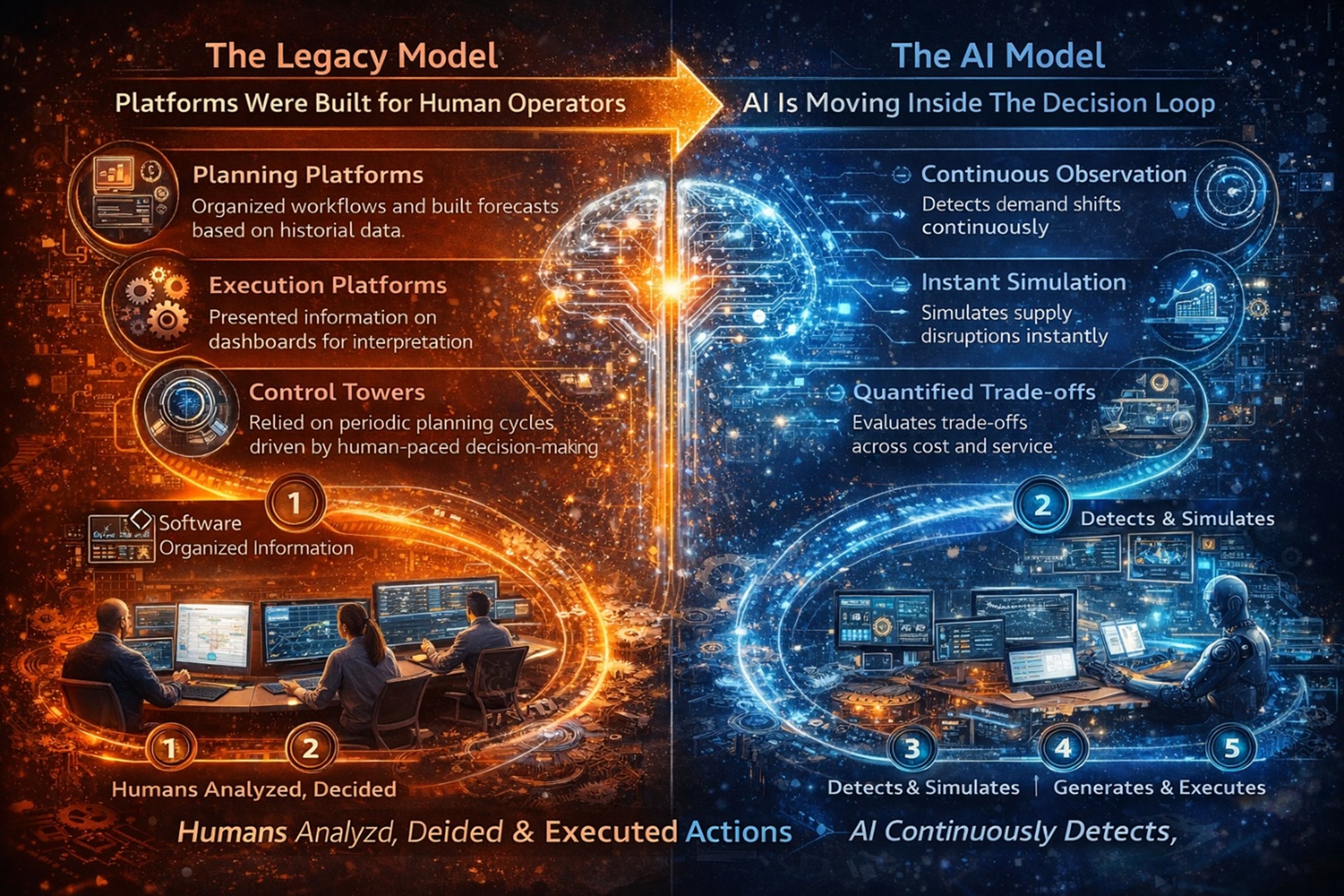
For the past twenty years, supply chain transformation has largely meant implementing platforms:
- Planning platforms.
- Execution platforms.
- Control towers.
These systems were built around human-paced decision loops.
Workflows structured how tasks moved through the organization. Dashboards presented information for interpretation. Planning cycles reflected the pace at which people could analyze and respond.
In other words:
Software organized information. Humans provided intelligence.
That model defined the platform era. But as AI becomes embedded deeper into enterprise systems, the architecture of these platforms is beginning to change.
AI IS MOVING INSIDE THE DECISION LOOP
The first wave of AI in supply chains focused on visibility.
- Better forecasts.
- Improved anomaly detection.
- Faster analytics.
But the next phase is more fundamental. AI is no longer just generating insights. It is beginning to participate directly in operational decisions.
Modern systems are increasingly capable of:
- Detecting demand shifts continuously
- Simulating supply disruptions instantly
- Quantifying trade-offs across cost and service
- Generating recommended actions in real time
In some cases, they can even execute responses automatically within defined guardrails. When that happens, the architecture of the system itself changes. The system is no longer just coordinating workflows. It is orchestrating decisions.
SUPPLY CHAINS ARE BECOMING NETWORKS OF AGENTS
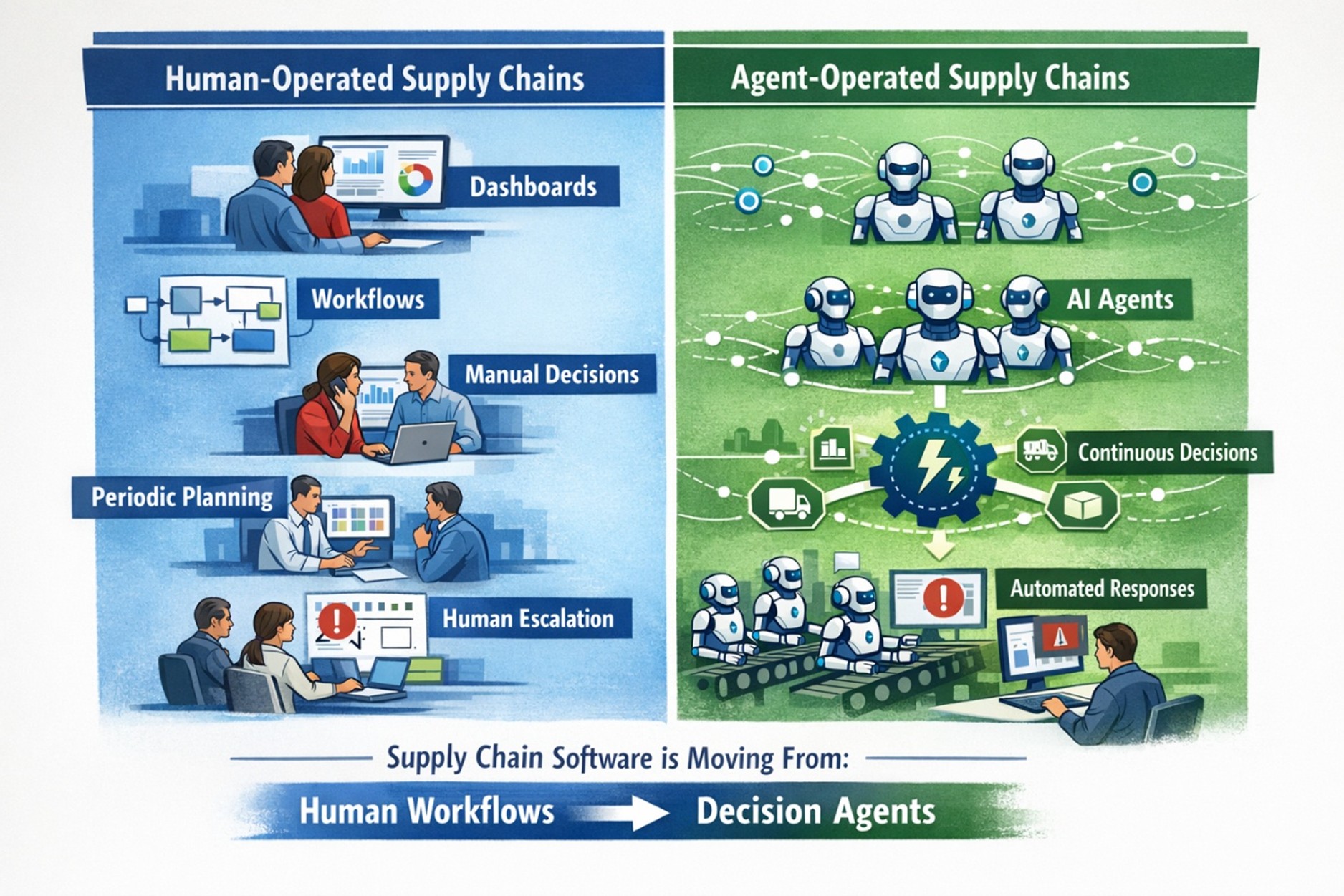
As intelligence spreads across enterprise systems, supply chains are beginning to resemble networks of cooperating agents rather than platforms operated by users. These agents are already emerging in early forms across modern implementations.
For example:
- Signal agents monitor demand and execution signals continuously.
- Risk agents scan supplier networks and logistics flows for disruptions.
- Scenario agents simulate mitigation options automatically.
- Execution agents trigger responses when predefined thresholds are exceeded.
- Instead of users navigating workflows step by step, agents exchange signals, propose actions, and escalate decisions only when necessary.
- Software shifts from being an interface layer to being an intelligence layer.
Software Design Is Changing Along With It. This transition is already reshaping how supply chain systems are built. Interfaces Are Becoming Less Central.
In the platform era, value was delivered through screens:
- Dashboards
- Planning workbenches
- Workflow queues
- Reporting layers
In agent-driven systems, value resides deeper in the architecture:
- APIs
- Event streams
- Orchestration engines
- Decision governance layers
The system’s role shifts from presenting information to directing action.
PLANNING IS BECOMING CONTINUOUS
Traditional planning cycles exist largely because humans need them.
- Weekly planning meetings.
- Monthly S&OP cycles.
- Quarterly network reviews.
But agent-driven systems can monitor signals continuously. They simulate outcomes instantly and escalate only when conditions exceed predefined thresholds. Planning stops being a scheduled activity. It becomes a continuous adaptive process embedded in the system itself.
IMPLEMENTATION BECOMES INTELLIGENCE DESIGN
As architecture evolves, implementation work changes as well.
Traditional supply chain transformations focused on:
- Configuring workflows
- Mapping business processes
- Building dashboards
Agent-driven systems require something different.
Organizations must now define:
- Decision guardrails
- Escalation thresholds
- Model priorities aligned with business objectives
- Governance for automated decisions
Implementation shifts from process engineering to intelligence engineering.
WHAT THIS MEANS FOR SUPPLY CHAIN SOFTWARE
This architectural shift has major implications for the next generation of enterprise systems.
Future supply chain platforms will be defined less by their modules and more by their ability to:
- Coordinate distributed intelligence
- Govern automated decisions
- Integrate signals across ecosystems
- Manage decision velocity across networks
The competitive frontier moves away from feature depth toward decision orchestration. Integration architecture becomes more important than user interface design. And platforms increasingly act as orchestration layers for intelligent agents.
THE STRATEGIC QUESTION FOR SUPPLY CHAIN LEADERS
This transition is already underway. Supply chains are moving from systems that support decisions to systems that participate in making them.
That raises important strategic questions for leaders:
- Where should automation act independently?
- Where must human judgment remain central?
- How should decision authority be distributed across systems, teams, and agents?
These are not just technology decisions. They are architectural decisions that shape how supply chains operate.
THE NEXT PHASE OF SUPPLY CHAIN SOFTWARE
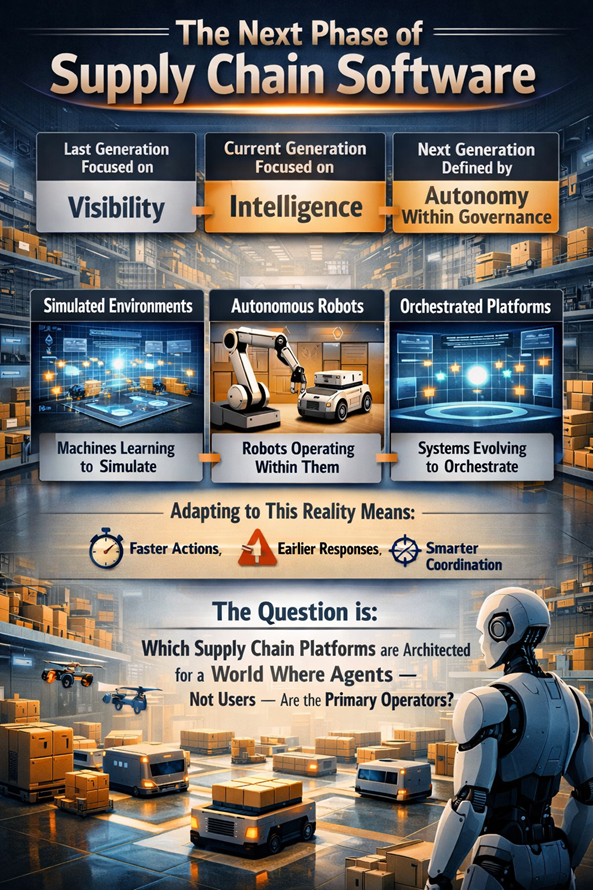
The last generation of supply chain software focused on visibility. The current generation focuses on intelligence. The next generation will be defined by autonomy within governance. Machines are learning to simulate environments. Robots are learning to operate within them. And supply chain platforms are evolving to orchestrate both.
The organizations that adapt their architecture to this reality will operate faster, respond earlier, and coordinate more effectively than those still structured around human-paced workflows. The real question now is not whether this shift will happen.
The question is:
Which supply chain platforms are architected for a world where agents — not users — are the primary operators?