share
How AI can be leveraged convert repetitive and time-sensitive tasks in a Supply Chain implementation project into a reliable end-to-end automated process
At one point in a supply chain implementation, a critical report had to be generated at exactly the right time, round the clock — often burning the midnight oil — or the data would be lost entirely. Working longer hours wasn’t the solution. Rethinking the process was. And I was approaching this not as a developer, but as a supply chain consultant with no formal coding experience. This became the starting point for my journey into AI-assisted automation.
For an Order Promiser implementation project, a report needed to be generated after every run.
- Order promiser runs could happen at any time of the day, including midnight.
- Another run could begin within a few hours.
- Data from the previous run would be overwritten.
- Missing the extraction window meant losing the data permanently.
Expecting someone to stay awake at odd hours every day was not sustainable. This wasn’t a productivity issue, rather it was a process design issue. Automation was no longer a necessity; it became the need of the hour.
The starting point: no technical background, only process understanding
As a functional supply chain consultant, I did not come from a technical or coding background. All I had was:
- A clear problem statement
- An understanding of the manual steps
- Knowledge of what the final report needed to look like
Instead of asking, “How do I code this?”, the perspective shifted to a different question
“If I explain every manual step clearly, can AI help me convert it into an automated flow?” That shift in thinking changed everything.
Breaking the problem down — step by step
The first thing I did was write the problem down exactly as it existed, without thinking about automation at all. This can be imagined as lego building blocks, starting small with a tiny square of thought.
I documented the existing manual process in detail:
- Which tables were queried
- What filters were applied
- How the tables were extracted
- How Excel pivot tables were built
- How the final report was shared with stakeholders
Once this was written down, the focus shifted to breaking the problem into the smallest possible actionable steps.
Every manual intervention, no matter how small, was treated as a separate step and questioned:
- Does this step always happen the same way?
- Is it rule-based or does it require judgment?
- If it is rule-based, can it be executed without human intervention?
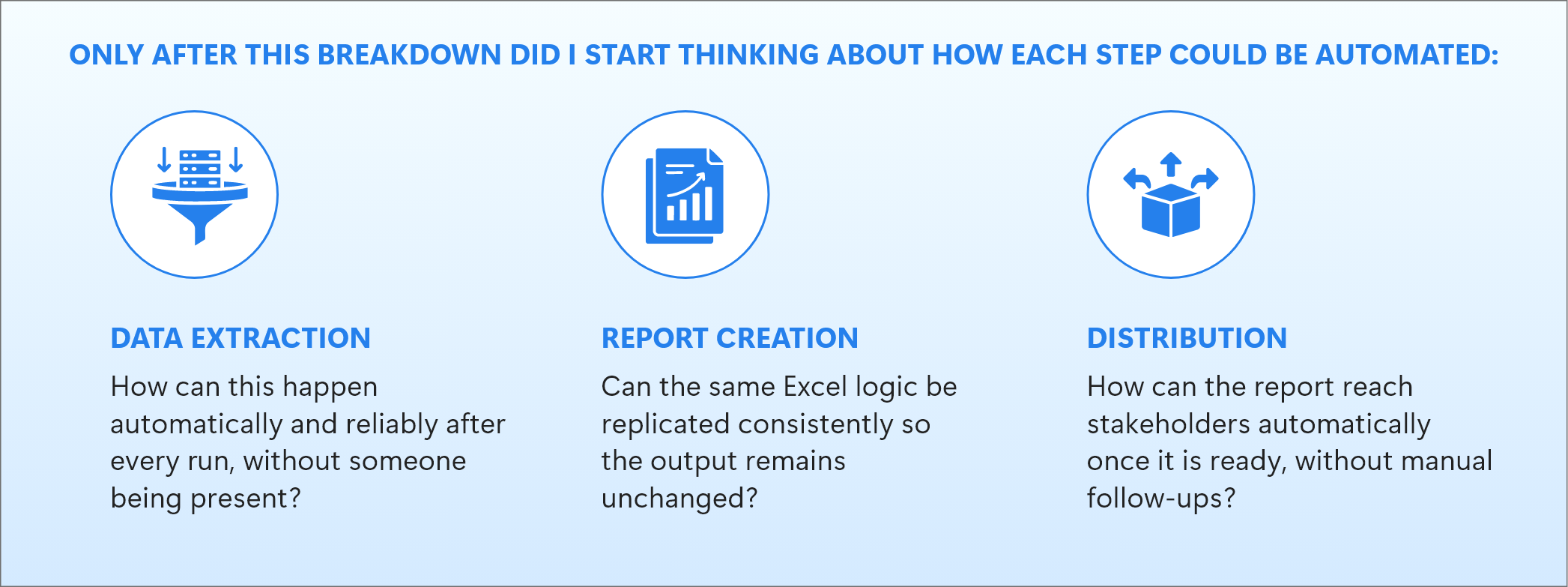
At this stage, I also leveraged AI to help me reason through which type of tool or approach would best support each tiny manual action and how all these steps could be stitched together into a single flow.
Major use of AI came here as an execution aid
Once the logic was clear, I used AI to:
- Convert business logic into SQL queries
- Translate Excel-based transformations into Python logic
- Identify how different steps could be chained together
- Refine scripts, handle syntax issues, and think through edge cases.
AI didn’t magically build the solution. Using functional understanding AI can be guided, in return technical execution will be handled by AI. AI became the bridge between what I understood from a business and process standpoint and what the system needed to execute reliably. I was encouraged to think of AI as a coding assistant- not something that replaces thinking, but something that supports it. That shift in perspective made the entire problem feel approachable.
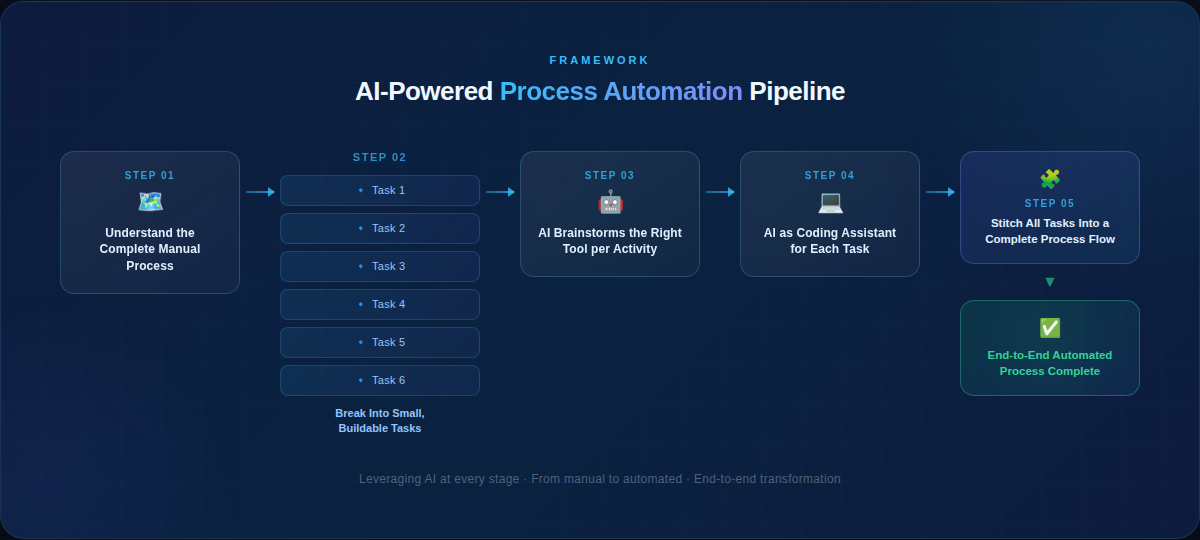
Image caption: Process at a glimpse
The outcome: a fully automated post-run report
The final solution achieved the original goal:
Once a run completes, the report is generated automatically
- Data is captured before it can be overwritten
- The report is uploaded
- A link is shared with stakeholders without any manual intervention
More importantly, this proved something personal and powerful:
A functional consultant, with the right problem framing, can design automation even without a technical background.
This project became a reference framework for me. It wasn’t just a solution to a single problem statement, but rather an approach that one could reuse to address similar challenges going forward.
Why this matters for supply chain professionals
Many supply chain professionals hesitate around automation because it feels too technical.
In reality, automation starts with clarity in understanding the problem, coding comes in much later.
If we can:
- Write the problem down clearly
- Break it into small, actionable steps
- Identify repetition and dependencies
- Define what “correct output” looks like
AI can help you do the rest.
In Part 2, I’ll show how this was used as a reference framework and how it was reused to solve other supply chain automation problems — across different datasets, validations, and reporting workflows, without starting from scratch each time.
