share
The Automation Question Supply Chains Are Quietly Asking
Across supply chain teams today, the conversation has shifted.
It’s no longer: “Should we automate?”
It’s now: “What kind of automation actually works in messy enterprise environments?”
Between legacy portals, supplier dashboards, Excel workflows, and ERP screens, most real supply chains don’t run on clean APIs.
They run on interfaces. And that’s where the real automation battle is happening.
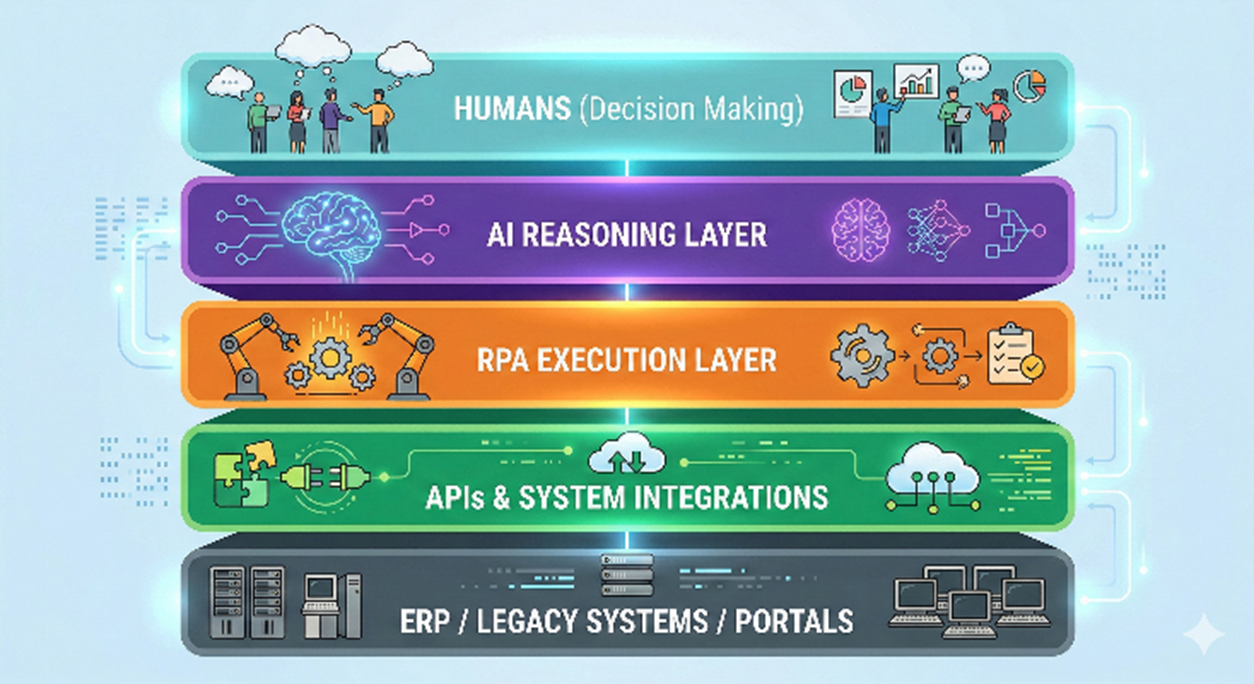
Enterprise automation is not one technology — it’s a stack.
My First Bet: Computer-Use Agents Will Run the Enterprise
When computer-use agents became viable, I was convinced they were the answer.
The promise was powerful:
- AI sees the screen
- AI clicks like a human
- AI interprets context
- AI runs workflows end-to-end
For supply chain execution — from tracking orders to updating portals — it sounded like the holy grail. So I started experimenting with the idea that: “Agents will replace traditional automation entirely.”
The Reality Check: Tokens, Screenshots, and Cost Curves
Then came the practical reality.
Computer-use agents rely heavily on:
- Continuous screenshots
- Image interpretation
- Context reconstruction each step
- Large token consumption per action
For complex workflows, this meant:
- High compute cost
- Latency at scale
- Reduced predictability
- Harder monitoring
It wasn’t that agents didn’t work. They did.
But for repeatable structured UI workflows, they felt like using a self-driving car to move a trolley inside a warehouse.
Technically impressive. Operationally inefficient.
The Pivot: AI + RPA Instead of AI Alone
That’s when I changed my mental model.
Instead of asking: “Can AI do everything?”
I started asking: “Where should AI think, and where should automation execute?”
That led me to a hybrid approach:
- AI for reasoning and workflow design
- RPA for deterministic execution
I started building flows in Power Automate, with ChatGPT acting as my:
- product expert
- co-architect
- troubleshooting partner
- workflow designer
It became a collaborative exploration rather than a tool experiment. And surprisingly, it worked extremely well.
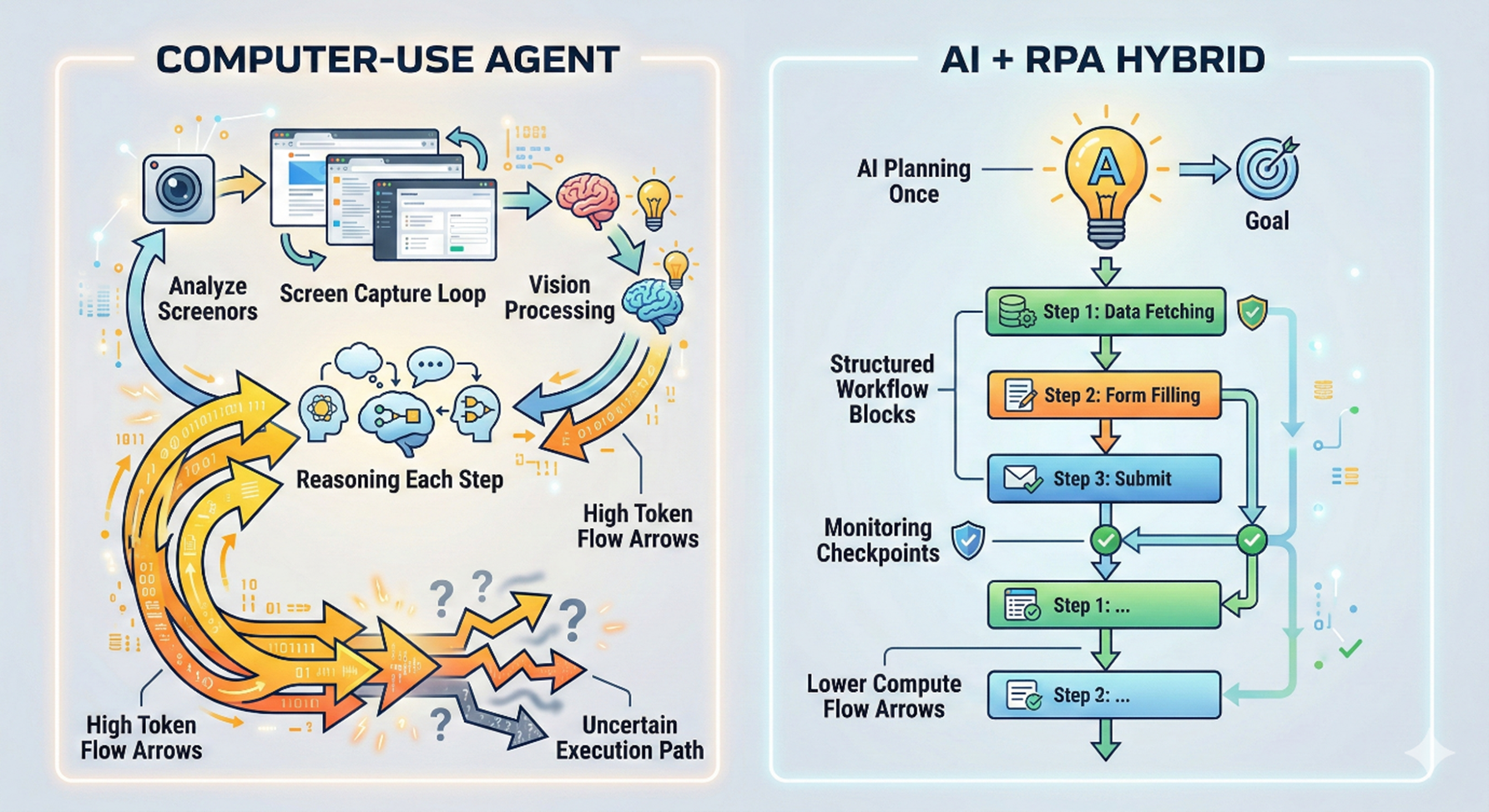
Agents reason continuously. Hybrid automation reasons once and executes repeatedly.
How I Used ChatGPT as My Co-Architect
Instead of treating AI as a black box, I treated it like a senior automation consultant.
I would:
- describe the business objective
- outline the system landscape
- explain constraints and UI behavior
- ask for flow logic and failure handling
Then iterate.
Together, we:
- explored multiple automation patterns
- tested selectors and triggers
- designed repeatable structures
- built monitoring checkpoints
The result wasn’t just a flow. It was a repeatable automation design approach.
Where This Hybrid Model Works Brilliantly
This model shines in scenarios that supply chains deal with daily:
- Supplier portals without APIs
- Manual shipment status checks
- Updating multiple systems with the same data
- Order confirmations across platforms
- Compliance document uploads
- Structured exception handling
For these use cases, AI-augmented RPA is:
- easier to execute
- easier to monitor
- easier to modify
- significantly more cost-efficient
You get the intelligence of AI
without the operational unpredictability of full agents.
Why This Matters for OEMs, Partners, and Operations Leaders
For OEM ecosystems and supply chain networks, this isn’t just technical architecture.
It’s about scalable execution.
Because automation success isn’t measured by: how smart the system is
It’s measured by: how reliably it runs across thousands of transactions.
The hybrid model provides:
- faster deployment cycles
- lower operational risk
- easier governance
- clearer ROI visibility
And in supply chain environments, that matters more than elegance.
A Practical Framework for Choosing Automation Approaches
Here’s the mental model I now use:
Use Computer-Use Agents when:
- tasks are unstructured
- UI layouts change frequently
- reasoning matters more than repetition
- workflows are exploratory
Use AI-Augmented RPA when:
- workflows are structured
- screens are predictable
- volume is high
- reliability is critical
- cost efficiency matters
This isn’t about choosing one over the other. It’s about placing intelligence in the right layer.
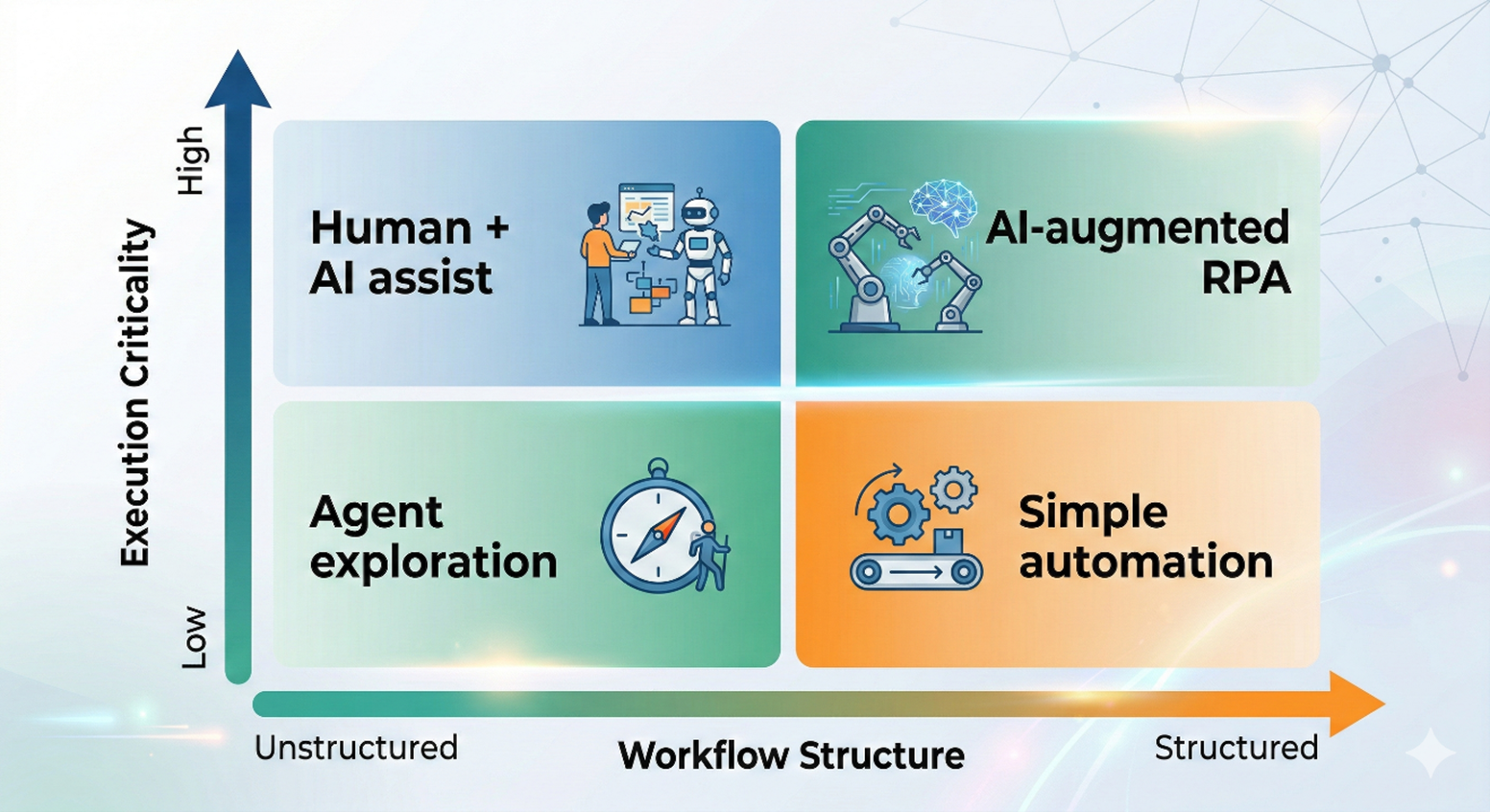
The right automation approach depends on workflow structure and execution risk.
Final Thought: The Future Isn’t Agent vs RPA — It’s Orchestration
The real future of enterprise automation won’t be agent-only or RPA-only.
It will be layered automation:
- AI for thinking
- RPA for execution
- APIs for scale
- humans for judgment
That’s the model I’m increasingly seeing succeed in real supply chain environments.
If this framework sparks ideas for new automation use cases in your organization, I’d love to hear them.
What workflows in your supply chain still depend on manual UI interactions today?
