share
Evaluating the most critical infrastructure decision for modern supply chains and planning systems.
The Debate is Evolving — Not Disappearing
In boardrooms and IT war rooms alike, one debate refuses to go away: Should your organisation move to the cloud, or should it stay with its trusted on-premises setup?
For years, the narrative was simple — cloud was the future, and on-premises was legacy. But as we move through 2025, that narrative is no longer accurate. Because the reality today is far more nuanced.
Most enterprise systems — especially in supply chain planning — no longer sit at either extreme. Instead, they fall into one of these categories:
- Licensed on-premises or appliance-based deployments — the customer purchases a software license and owns or controls the underlying infrastructure. Modern variants include pre-integrated hardware appliances (such as Oracle Database Appliance / ODA) that may be cloud-managed for support but keep compute and data fully on-site.
- Cloud-hosted licensed systems — licensed software deployed on public cloud infrastructure (e.g. AWS, Azure), managed by the customer rather than the vendor.
- Fully managed SaaS platforms — the vendor hosts, operates, and upgrades the entire platform. Customers subscribe and access over the internet.
- Hybrid combinations of both
At a Glance: What Are We Actually Comparing?
The traditional comparison between “cloud” and “on-premises” often oversimplifies reality. A more accurate picture today looks like this:
What’s Driving Cloud and SaaS Adoption?
The momentum behind cloud and SaaS adoption remains strong — but the motivations are evolving:
- Elastic scalability — especially important for planning runs, simulations, and peak workloads
- Faster deployment cycles — reduced infrastructure lead times; SaaS platforms are pre-provisioned
- Global accessibility — critical for distributed supply chain teams
- Reduced infrastructure management — particularly in SaaS models, where the vendor absorbs operational overhead
- Predictable OpEx — subscriptions replace large upfront capital outlays, which suits modern finance and PE-backed businesses
For supply chain organisations, cloud and SaaS have enabled faster adoption of advanced planning capabilities without heavy upfront infrastructure investment.
But Then Reality Struck — The Operational Risk Layer
Recent high-profile outages across major cloud providers have added a new dimension to this discussion.
These incidents highlighted an important truth: Moving to the cloud does not eliminate risk — it repackages it.
When a SaaS platform goes down, every customer on that platform goes down with it — simultaneously, and with no control over recovery timelines.
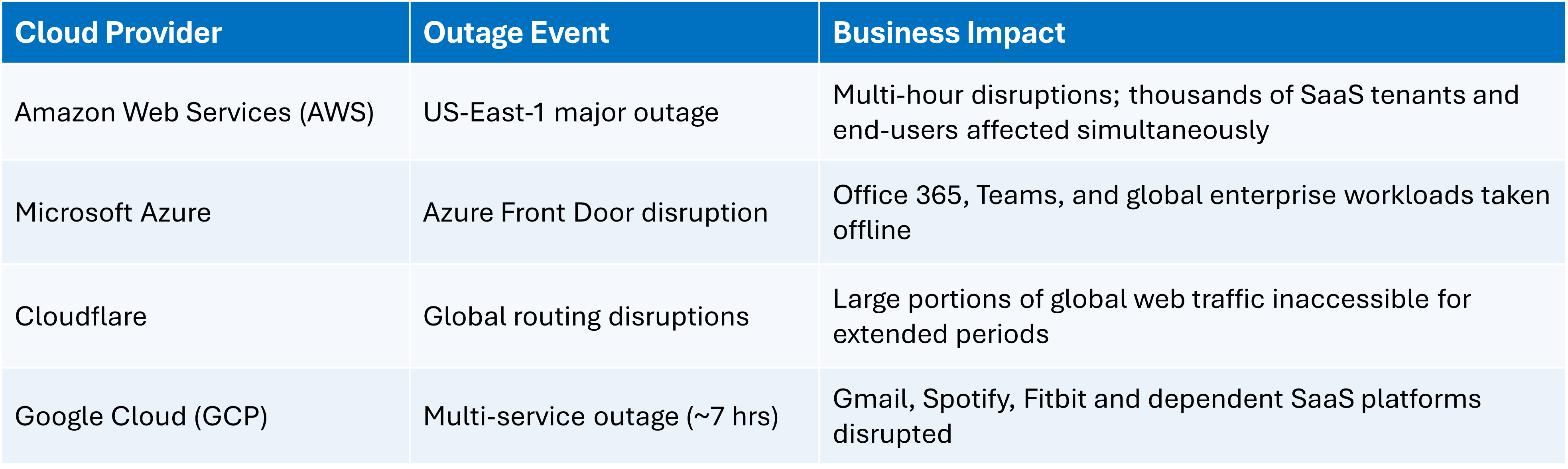
Note: Outage events referenced above are based on publicly reported incidents. Specific dates and impact figures should be independently verified before publication. These examples are illustrative of a broader pattern, not an exhaustive or audited record.
For APS deployments, the implications of a SaaS outage during a critical planning window are significant:
• Missed S&OP consensus cycles — planning decisions delayed or skipped
• Interrupted overnight optimisation runs — plans not ready for morning execution
• Delayed procurement decisions — purchase orders miss lead time windows
• Inventory imbalances — replenishment signals not generated in time for peak periods
• Service level degradation — cascading into customer-facing availability failures
Even short disruptions can cascade into operational and financial impact — especially during S&OP cycles, end-of-month consensus runs, or peak season replenishment windows.
Does That Make On-Prem or Hosted Models Better?
Not necessarily. Each model comes with its own trade-offs:
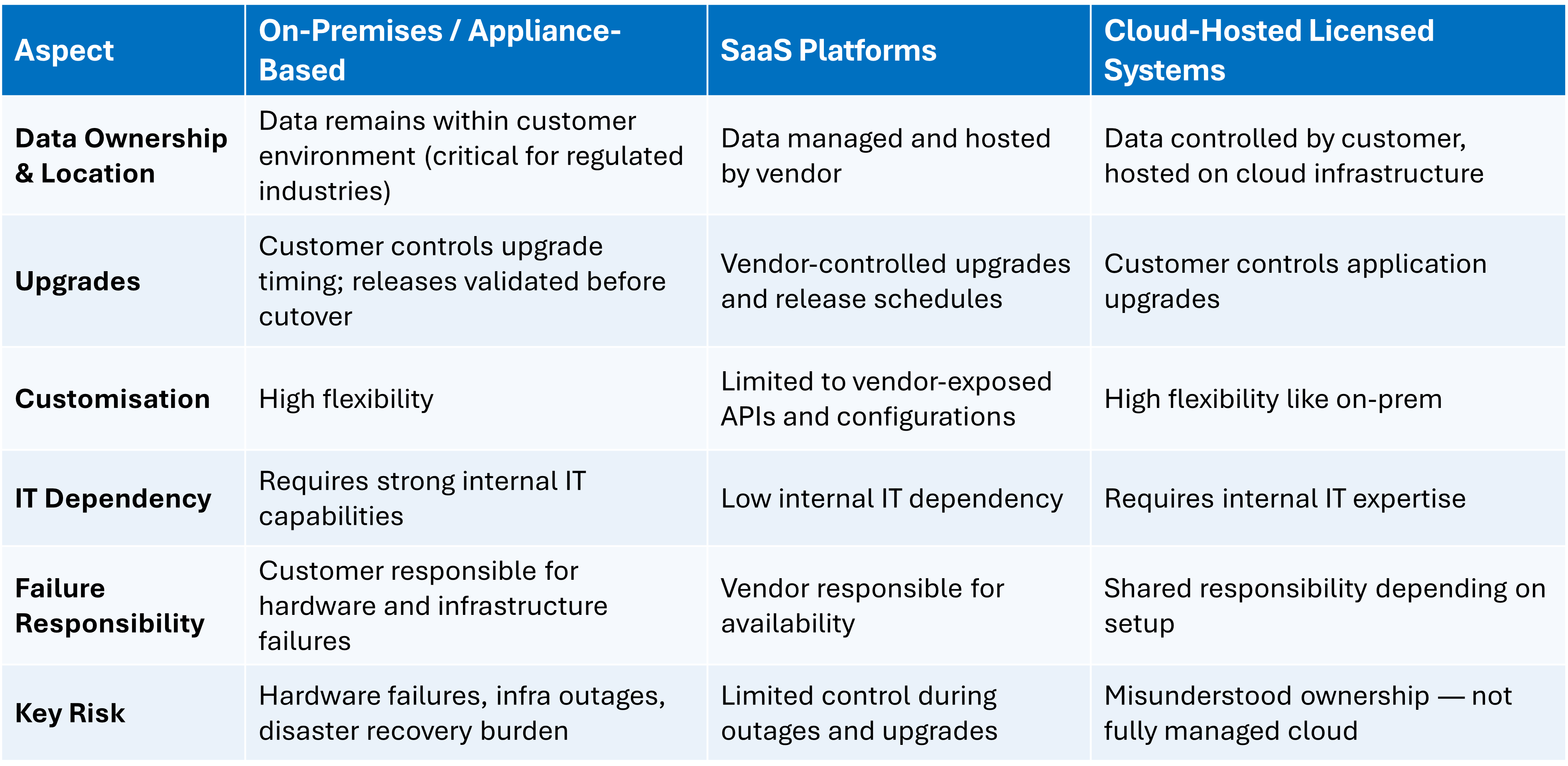
The key takeaway: Responsibility doesn’t disappear — it shifts.
The Real Decision Framework (For Supply Chain Leaders):
Instead of asking “cloud or on-prem,” organisations should evaluate:
- Control vs Convenience: How much control do you need over planning cycles, data, performance, and recovery timelines? Licensed on-premises provides the most; SaaS provides the least. The more critical the planning cycle to your business outcomes, the stronger the case for retaining control.
- Risk Ownership: Who is accountable during downtime — your team or the vendor? In SaaS, recovery is the vendor’s responsibility — but so is the timeline. In licensed on-premises, recovery is yours — but so is the capability. Know which you have before you commit.
- Business Criticality and Cost of Failure: What is the actual cost of a missed planning run — in procurement delays, inventory imbalances, expediting costs, or service level failures? Higher cost of failure argues directly for higher control. Do not delegate recovery to a vendor SLA if the cost of that delay is material.
- Internal IT Capability and Appetite: Do you have — and want to maintain — the internal expertise to manage infrastructure? Licensed deployments require skilled infra and platform teams. SaaS reduces that burden but introduces a different dependency on vendor capability and responsiveness.
- Vendor Roadmap Alignment: Where is the next generation of APS functionality being built — on the SaaS platform or the licensed product? Choose the model which is actively invested in. A licensed product that has become a maintenance track is a slow-motion migration in disguise.
The Rise of Hybrid Architectures
Many leading supply chain organisations are no longer choosing one model. Instead, they are designing intentional architectures — combining models based on workload type, data sensitivity, and operational criticality.
Patterns that are emerging in practice:
- Core planning engines on licensed on-premises or appliance — complex optimisation, master data, and sensitive planning outputs remain in controlled, low-latency environments.
- Collaboration and visibility layers on SaaS — demand sensing, supplier portals, S&OP workbenches, and network visibility tools benefit from SaaS accessibility and ease of adoption.
- Integration fabric connecting both — APIs, event streaming, and data lakes bridge the two environments, allowing data to flow without compromising the control model of either.
- Explicit fallback and recovery strategies — regardless of deployment model, planning resilience requires designed fallback procedures for critical planning cycles.
This is not a compromise. It is strategic distribution of risk and capability across the architecture.
Hybrid is particularly relevant for global supply chains where planning is centralised, but execution data originates across geographies with different regulatory requirements, latency profiles, and IT maturity levels.
A More Honest Conclusion
The cloud vs on-premises debate is no longer about location. It is about ownership, accountability, and operational resilience — and it plays out differently for every supply chain.
Cloud is not inherently superior. On-premises is not inherently outdated. SaaS is not inherently risk-free. Each model optimises for a different set of priorities. The organisations that get this right are not the ones that followed the prevailing trend — they are the ones that matched their deployment model to their actual operational requirements.
From experience across APS implementations on platforms, the most consequential failures in planning transformations rarely come from the technology itself. They come from misaligned expectations about who owns what — and from deployment model decisions made on vendor recommendation rather than business logic.

Final Thought
The question is no longer: Should we move to the cloud?
It is: What should we control, what should we delegate — and how do we stay resilient when things fail?
Because in modern supply chains: Resilience is not built by choosing a platform — but by designing for failure.
This article is intended for informational and discussion purposes only. Technology vendor capabilities, pricing models, product roadmaps, and market positions evolve continuously — all vendor-specific details should be validated directly with the relevant vendor. Outage data referenced is based on publicly reported information and is illustrative of broader industry trends, not an exhaustive or audited record. Readers are encouraged to conduct independent due diligence before making infrastructure or commercial decisions.
