share
THE OPPORTUNITY: ALIGNING TECHNOLOGY WITH BUSINESS READINESS
A Transportation Management System (TMS) can create significant value for an organisation managing a large and complex outbound logistics network. By bringing transportation planning, carrier allocation, freight costing, tracking and settlement into a more connected environment, it can improve visibility, consistency and control across warehouses, transporters and freight lanes.
Recognising this opportunity and engaging an implementation partner are important first steps. The experience of a TMS rollout, however, highlights a broader project management lesson: successful technology delivery depends not only on selecting the right platform, but also on ensuring that the business processes, decisions and ownership required to support it are sufficiently defined.
The key learning is not that the organisation should have had every answer at the outset. Rather, process discovery and business alignment need to be treated as deliberate project workstreams, with clear ownership, deliverables and decision points.
A TMS ENABLES BUSINESS RULES; IT DOES NOT DEFINE THEM
A TMS operationalises business decisions. These may include freight rating, carrier selection, load-building constraints, service-level agreements, penalties and exception-handling procedures. During implementation, these principles are translated into system configuration, workflows and integrations.
Where processes are undocumented or vary across locations, the project team may need to spend additional time establishing the current state and agreeing the future state before configuration can progress with confidence. In the absence of agreed business rules, an implementation partner may be required to work with assumptions, standard product templates or inputs from individual stakeholders. These can be useful starting points, but they should be validated by the business before they become the basis for a solution.
From a project management perspective, this is an important distinction: the implementation partner brings product and implementation expertise, while the organisation remains accountable for its operating model, business priorities and policy decisions.
WHAT THE ROLLOUT EXPERIENCE BROUGHT TO LIGHT
The rollout surfaced several areas that are common in complex, multi-site transformation programmes and offer valuable opportunities to strengthen delivery readiness:
- Process knowledge was largely held by individuals and maintained through local practices or spreadsheets, rather than captured in a consistent set of process documents.
- Operating practices differed across warehouses, including dispatch planning, load building, carrier selection and exception management. These differences needed to be understood and assessed before a common solution could be defined.
- A consistent enterprise-wide process had not yet been established. As a result, the project faced additional design decisions at individual sites and a greater need for business alignment.
- Business ownership and decision rights needed to be made more explicit, particularly where local requirements conflicted or where standardisation required a trade-off.
For a programme team, these findings should be treated as discovery outcomes rather than simply delivery blockers. They help establish the true scope of change, identify the decisions that need leadership input and make dependencies visible early.
CHANGE MANAGEMENT IS A CORE DELIVERY WORKSTREAM
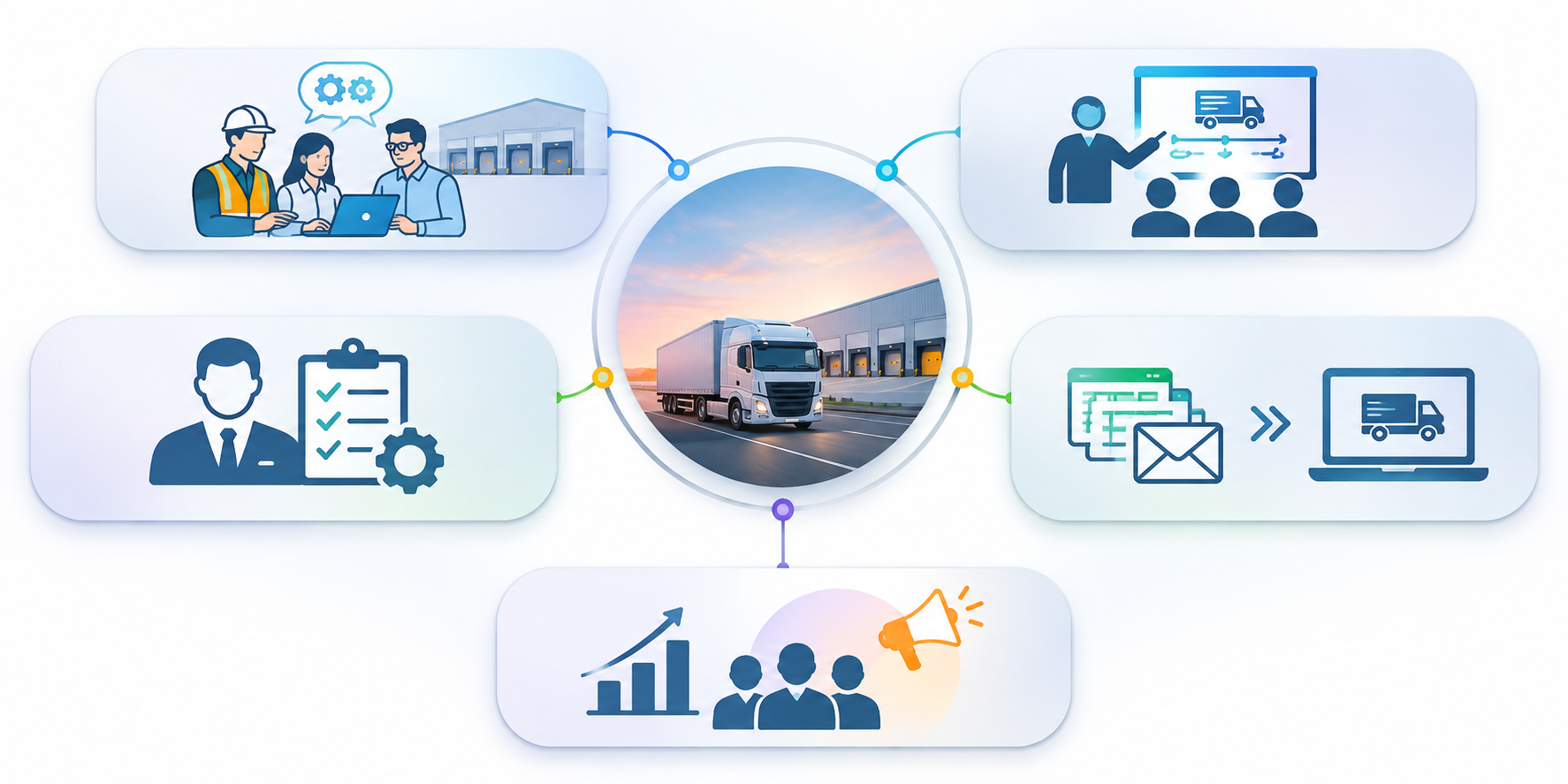
Technology adoption is most effective when the people and processes around the system are prepared to change. A TMS rollout affects day-to-day responsibilities across planning, warehouse operations, transport teams and management. Their involvement is therefore essential from discovery through deployment and stabilisation.
The rollout highlighted several areas that deserve early and sustained attention:
- Engage warehouse and transport users in process discovery and solution design so that operational realities are represented and ownership is built early.
- Plan role-based training around the future-state process and the decisions users will make, rather than limiting training to system navigation or screen demonstrations.
- Assign accountable business process owners who can validate requirements, resolve cross-site differences and support consistent adoption.
- Identify existing workarounds, such as spreadsheets and informal communication channels, and agree how they will be transitioned or retired.
- Define adoption measures and reinforce the expected ways of working through leadership communication, operational reviews and post-go-live support.
Where the new system and established local practices do not initially align, the project should provide a structured mechanism to assess gaps, make decisions and manage exceptions. This is more sustainable than allowing parallel processes to continue without clear ownership.
A PRACTICAL PROJECT MANAGEMENT APPROACH
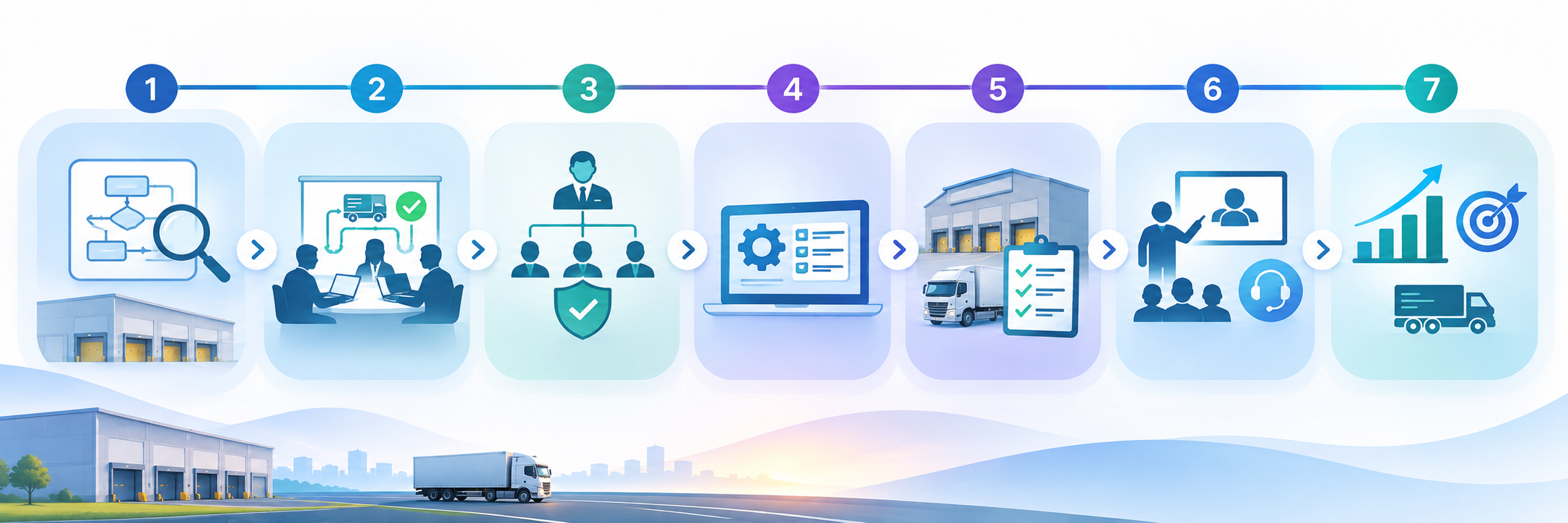
A structured readiness and delivery approach can help reduce ambiguity, improve decision-making and create a stronger foundation for rollout. The following sequence provides a practical framework:
- Establish the current state: Document the end-to-end transportation processes across representative warehouses. Capture common steps, local variations, pain points, systems and existing workarounds.
- Define and approve the future state: Facilitate business workshops to agree standard principles for freight rating, carrier allocation, load building and exception management. Record decisions, assumptions and approved variations.
- Confirm governance and ownership: Nominate business process owners and decision-makers. Establish a governance forum, decision log, escalation path and clear accountability for requirements and sign-offs.
- Translate requirements into solution design: Provide the implementation partner with approved business requirements and process flows. Validate the proposed configuration against those requirements and track gaps, dependencies and product constraints.
- Pilot, learn and refine: Pilot the solution at one or two representative warehouses. Use defined scenarios and business KPIs to validate the design, capture feedback and resolve issues before scaling.
- Prepare users and operations for change: Deliver role-based training, readiness assessments and communication. Confirm support arrangements and agree a controlled transition from legacy workarounds.
- Measure adoption and business outcomes: Track measures such as the percentage of shipments planned in the TMS, system usage, exception volumes, freight-cost variance and other agreed operational KPIs.
KEY PROJECT MANAGEMENT LEARNINGS
- Treat business process discovery as a formal project deliverable, not an informal prerequisite.
- Make business decisions, ownership and sign-offs explicit. Technology teams and implementation partners should not be expected to make policy decisions on behalf of the business.
- Surface process variations and product limitations early, then assess them through structured fit-gap analysis and impact assessment.
- Build change management, stakeholder engagement and training into the integrated project plan from the beginning.
- Use pilots and measurable acceptance criteria to validate the solution with real operational scenarios before broader deployment.
- Track readiness and adoption alongside technical milestones. A system can be configured and deployed while the organisation is still working towards operational readiness.
THE TAKEAWAY: READINESS IS A SHARED RESPONSIBILITY
A successful TMS transformation is the outcome of coordinated effort across the business, the implementation partner and the technology teams. The platform provides the capabilities; the business defines the operating principles; and the project management approach brings these elements together through governance, planning, risk management, stakeholder engagement and disciplined execution.
The experience reinforces a constructive lesson for future transformation programmes: when process knowledge is fragmented or requirements are still evolving, make that visible early and address it through structured discovery, business-led decisions and incremental validation. These activities are not detours from implementation. They are essential parts of implementation.
Before configuration scales across the network, invest in understanding how the organisation operates today, agreeing how it intends to operate tomorrow and preparing people to make that transition. Strong business readiness gives the technology a much better chance of delivering its intended value.
